What is quantity takeoff?
Quantity takeoff measures every item of a building from its drawings. Manual and digital takeoff, the method, and how Vextrus keeps the QS in charge.
Given a drawing as an image, an AI chatbot reads a picture of the sheet, not the drawing’s geometry, and the same question can get a different answer. In one published test, AI models miscounted even the doors on floor plans. Vextrus keeps language models out of measurement: code measures, small local models only propose, and the QS confirms.
39%
Best of ten AI models: door count exactly right on only 39% of plans.
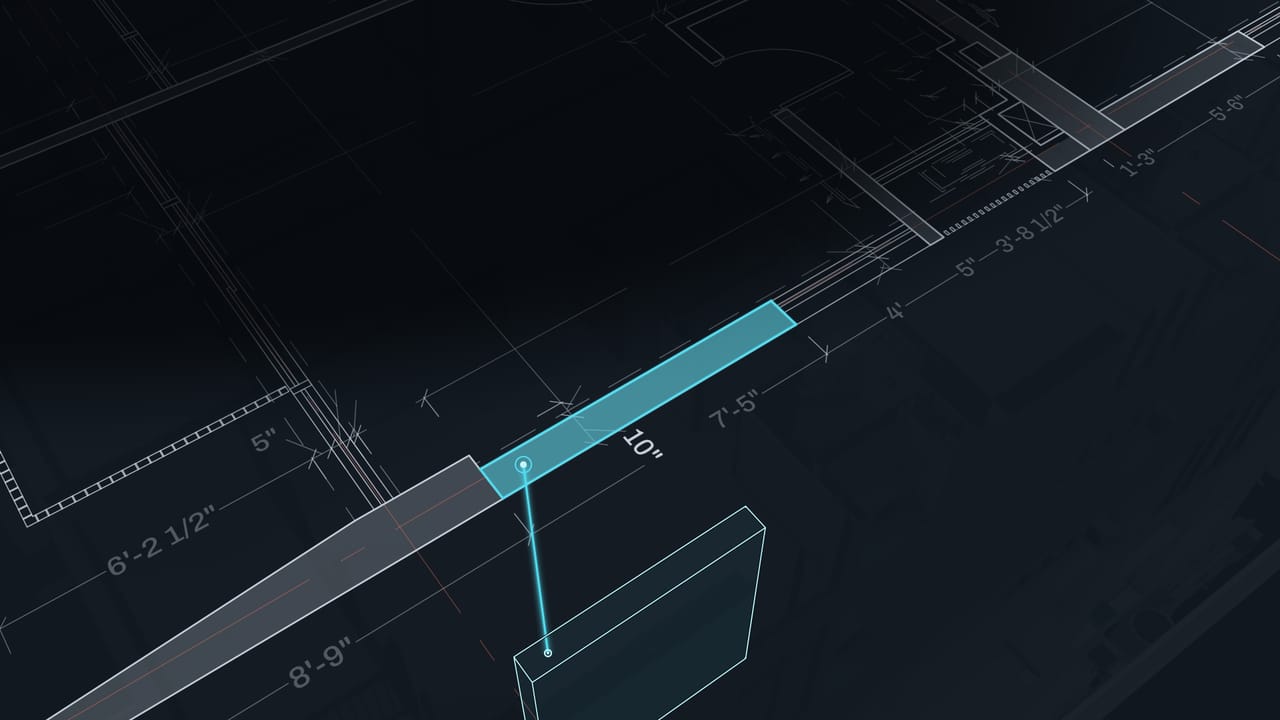
Given a drawing as an image, a general AI chatbot sees a picture of the sheet: its lines and its text, as pixels. A drawing file holds more than that: every line with its exact ends, on its own layer, in the drawing’s own units. A count read from a picture is a reading of what the eye sees, not a measurement.
A person reading a sheet does the same at first glance. A QS then goes further: takes the dimensions, works each line, checks a schedule against its plan, and writes it all down so another QS can check it. A chatbot’s count arrives as a fluent sentence, with no measurement sheet behind it and no line on the drawing to re-measure. When it is right, nobody can show why; when it is wrong, nobody can show where.
A language model’s answer is generated afresh each time it is asked, so the same question can come back with a different answer, even on settings meant to make it repeat. For a quantity, that is the end of it: a figure that changes on a second asking cannot be signed.
A published test (Atil et al., arXiv preprint, 2025) asked five language models the same questions ten times each, on their “deterministic” settings, and their accuracy moved from run to run. The questions were general benchmark tasks, not drawings.
Vextrus works the other way. Run it again: the same drawings and the same Confirmations give the same result, because code computes every quantity and a model only chooses among options code has found. A figure moves only when what it rests on moves, such as a new Revision of the drawings or a new Confirmation by the QS. Same drawing, same answer.
up to 15%
Five AI language models, 'deterministic' settings, same questions, ten runs: accuracy varied by up to 15%.
When an AI model does not know, it can answer anyway, and a guessed figure reads exactly like a measured one: the same confident sentence, with nothing on it to say where the figure came from. A benchmark of general knowledge, not construction (AA-Omniscience, in Stanford HAI’s AI Index Report 2026), measured how often 26 top models guessed wrong when they did not know, and every one of them did.
On a drawing, the gaps are real: a level that is not given, a detail that is not drawn, a note that contradicts a plan. Vextrus keeps them visible. Every figure says how it was found: read, taken from the drawing with a Trace; inferred, made by a named rule, the rule shown; or a placeholder, counted with no quantity yet. A gap only the consultant can fill goes to the RFI list, with a provisional value labelled inferred until the answer comes, and it is never passed off as read.
22% to 94%
When they didn't know, 26 top AI models guessed wrong: 22% to 94%.
Vextrus splits the work so that no model measures. A deterministic core, Vextrus’s own DWG decoder, geometry, measurement and cross-checks, computes every quantity. Small local models read each set’s conventions, such as which lines are walls, columns and doors, and name objects where the layers do not say. The QS confirms. There is no language model in the engine.
The rule is written into the product: “Code computes every number; a model may only choose among candidates code found.” Each reading is a Proposal in a fixed form that code can check. Confidence comes from Checks against something independent of the reading, calibrated per Element class; a model’s own confidence never decides. The Takeoff uses no outside AI. Our own models run on our own servers; code measures every quantity, and every figure not read from the drawing names the rule that made it. See the AI in Vextrus and how Vextrus handles your data.
The Measurement Line
The figure is this plan’s own arithmetic.
A person still confirms because people follow wrong machine suggestions, experts included, and training does not stop it. So the check cannot be left to good intentions: it has to be built into the screen the QS works in. A study in radiology, not construction (Dratsch et al., Radiology, 2023), found that a wrong suggestion from a simulated AI pulled down the accuracy of even very experienced radiologists.
So Vextrus puts the safeguards in the screen, and all four are required:
A Proposal counts toward nothing until the QS confirms it, and every Confirmation is written to the Journal under the QS’s name. Any figure then opens its line on the drawing in three clicks. The machine proposes. The engine measures. The QS confirms.
See every article on the Learn page, or read what quantity takeoff is.
82% → 46%
With a wrong AI suggestion, very experienced radiologists fell from 82% to 46%.
A chatbot given an image of a sheet can describe it and offer a count, but the count is a reading of a picture, with no measurement sheet behind it and no line to re-measure, and it can change when the question is asked again. In Vextrus code computes every quantity, Vextrus's own models only propose, and the QS confirms.
No. No quantity comes from a language model, and there is no language model in the engine. Code computes every quantity, from the drawing's geometry where the drawing states it and by a named rule where it does not; Vextrus's own small local models read each set's conventions and name objects; the QS confirms. The rule behind each such figure is named on it.
The Takeoff uses no outside AI. Our own models run on our own servers; code measures every quantity, and every figure not read from the drawing names the rule that made it.
It is how Vextrus divides the work. The machine, Vextrus's own models, proposes what each line is, such as a wall or a column. The engine, deterministic code, computes every quantity: from the drawing's geometry where the drawing states it, by a named rule where it does not. The QS confirms, by exception, on the drawing, and only confirmed Elements count.
Quantity takeoff measures every item of a building from its drawings. Manual and digital takeoff, the method, and how Vextrus keeps the QS in charge.
The old idea of one database as a building's record, what BIM promised, and why Vextrus starts from the 2D drawing set a Developer already has.
A BOQ, or bill of quantities, lists every item of work in a building with its quantity and unit. What it holds, who makes it, and what Vextrus adds.
Drawn once. Every number traced.