One database for a building: the idea, and where the 2D drawing fits
The old idea of one database as a building's record, what BIM promised, and why Vextrus starts from the 2D drawing set a Developer already has.
A digital twin of a building is a digital model kept in step with the real building by data flowing back from it. A model handed over at completion is a Level 1 digital model (Dong & Moshood, Buildings (MDPI), 2026). In Vextrus, the Live Model goes with the building at handover and becomes its Digital Twin once the building’s own data flows back.
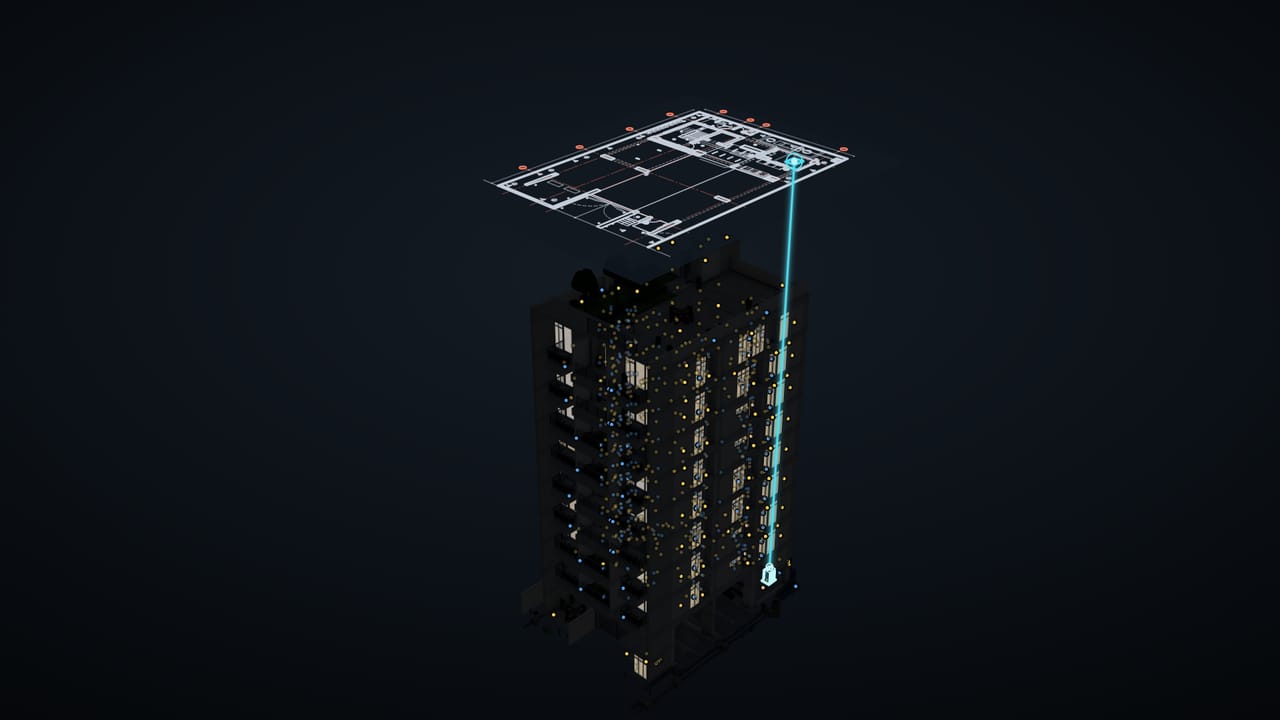
The difference between a digital model and a digital twin is the data flowing back. A digital model describes the building as it was designed, or as it stood on the day it was handed over. A digital twin stays in step with the building as it is run, because the building’s own data keeps coming back into it.
On one published scale (Dong & Moshood, Buildings (MDPI), 2026), the strict sense of twin, its Level 3, needs that flow to be automatic and two-way. A model handed over and never touched again stays at the first level: correct on the day the keys change hands, and older every day after. The word matters less than the test behind it: does the model still describe the building as it is today? For a Developer’s facility team the test is plain: when they open the model years after handover, is it the building they are standing in?
The data that flows back is what happens to the building after its drawings: what was actually cast and spent on site, where it differs from the design, and every warranty, service and repair after handover. In Vextrus each is a Record: a dated act that writes a value on an Element, naming who, when and on what evidence.
Each Element carries its values in three Life Phases. As designed comes from the drawings, Revisions and prices. As built is what was actually cast and spent on site. As maintained is warranty, expected life and upkeep after handover. One Element keeps one identity through all three, so a column’s design, its pour and its later repairs sit on the same thing. A Record never changes an As designed value, and a Deviation, a value that differs from its design beyond a tolerance, is shown beside the design value, never absorbed. A Developer may add Attributes of its own.
The record matters after handover because that is where a building spends most of its life, and so where a gap in its record costs its owners longest. A US study of non-residential buildings (NIST GCR 04-867, 2004) found that owners carry most of what poor data exchange costs, and that most of their share falls after handover.
In Vextrus, the Live Model goes with the building at handover, with its Records and its Journal. When you hand over, the record of what was drawn and what was built goes with the keys, on the same Elements, not in a binder. Your facility team starts on day one with every asset’s identity, warranty and history, found by clicking the asset, not by digging through folders. See Handover in Vextrus and Vextrus for facility managers.
US$15.8 billion a year
Owners carry two-thirds of what poor data exchange costs, 85% of it after handover.
The Live Model becomes a Digital Twin only when the building’s own data flows back into it. On the day of handover it is a Level 1 digital model, on that scale: every Element confirmed and traced to its drawing, carrying what was designed, what was built and who recorded each. From then on, what flows back into it decides what it becomes.
After handover, the As maintained Life Phase fills in: warranties, expected lives, upkeep and services, each written as a Record on the Element it belongs to. Each Record is a person’s act, under the name of whoever recorded it.
Once the building’s own data flows back, the Live Model becomes the building’s Digital Twin: every asset with its identity from the drawing, its warranty, its upkeep and its history. Vextrus never calls the Live Model itself a digital twin, and never calls it one before that condition holds. Years on, every asset keeps its history, and it still opens the line it was drawn from. See the Digital Twin in Vextrus.
A twin starts best from the drawing because the drawing is where every Element’s identity begins. A model made later, after the building is finished, has to work out again what each part is and where it came from. One that grows from the Live Model already knows, because each Element has kept its identity from its first line.
That is what makes the history worth keeping. A pump replaced years after handover sits on the same Element the services drawings showed, with the Record of its installation, its warranty and every service since. A repair to a column sits beside the column’s design and its As built Record, each naming who recorded it and when. The Records written while the building went up are already on the Elements the twin starts from, and every figure on them still opens its Trace. The record a Developer kept to build the building is the record its facility team inherits. Read why one database for a building matters.
See every article on the Learn page, and the terms in the glossary, including Life Phase and Record.
One published scale (Dong & Moshood, Buildings (MDPI), 2026) runs from Level 1, a digital model, to Level 3, a twin with automatic two-way data flow. A model handed over at completion is a Level 1 digital model. In Vextrus the Live Model is handed over at that level and becomes the building's Digital Twin once its own data flows back.
A Record is the dated act that writes an As built or As maintained value of an Attribute on an Element, naming who, when and on what evidence. It never changes an As designed value. A value that differs from its design beyond a tolerance is a Deviation, shown beside the design value, never absorbed.
Yes. In Vextrus every asset keeps its identity from the drawing, because the Digital Twin is the same Live Model, on the same Elements. Years after handover, an asset still opens the line it was drawn from, beside what was built and every service recorded since.
The old idea of one database as a building's record, what BIM promised, and why Vextrus starts from the 2D drawing set a Developer already has.
Given a drawing as an image, an AI chatbot reads a picture, not geometry. What published tests show, and how Vextrus keeps models out of measurement.
A BOQ, or bill of quantities, lists every item of work in a building with its quantity and unit. What it holds, who makes it, and what Vextrus adds.
Drawn once. Every number traced.